A contextual note:
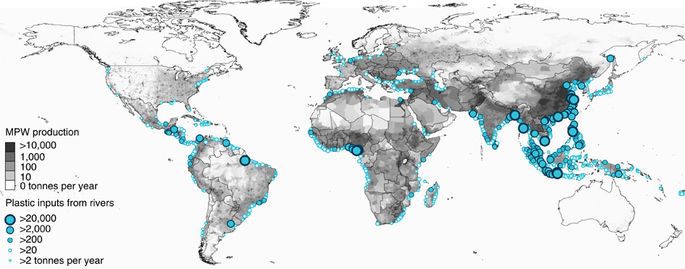
I'm currently living in Indonesia (which houses 4 of the top 20 polluting rivers) where I've observed a number of structural reasons why so much plastic waste is generated in the first place. Two of them are:
1. Waste management is not an embedded cultural practice yet. Many people burn their trash, and many more throw it onto the street or into the waterways. This is changing as the government invests more in waste management infrastructure, but that's a long game.
2. Inadvertent waste generation seemingly IS an embedded cultural practice. Food is packaged in plastic box, then a paper box, then a plastic bag. Then another plastic bag. Most consumable goods (shampoo, coffee, detergent) are packaged in mini sizes to keep unit prices down. These sizes inherently generate more packaging waste.
Like I mentioned, I'm a huge proponent of tackling these structural problems. However, as an engineer I'm also drawn to technological shortcuts. I realize interception systems are band aids applied to a much larger wound -- but they can still work.
Harrison Waschura49
Posted in Open Discussion
and visible to The Public
Are river debris interception systems implemented widely? THEY SHOULD BE
A recent study published in Nature Communications (https://www.nature.com/articles/ncomms15611) (funded by The Ocean Cleanup) calculated that roughly 2 million metric tons of plastic waste are swept into the ocean via rivers every year. The study further concludes that only 20 rivers (mostly in Asia) are responsible for 67% of this pollution.
This is a HUGE opportunity! Rivers are naturally concentrating waste, we should be leveraging that concentration and capturing this waste before it enters the ocean. Obviously this is not the preferred method for stopping marine pollution, I'd rather prevent the plastic from ever making it into the ecosystem, but it's a whole lot better to stop it before it gets to the ocean and can degrade into microplastic.
A 2015 study (http://science.sciencemag.org/content/347/6223/768) estimated that the overall flow of plastic waste into the ocean is between 4.8 - 12.7 million metric tons of plastic per year.
Creating a small handful of River Interception systems could have a meaningful impact on marine plastic pollution ( Potentially one fifth of total yearly marine plastic pollution!)
I'm interested to hear what you know about river waste management. How widely are these systems already deployed? In the U.S.? In your country? In the countries with the top-polluting rivers?
The Baltimore harbor implemented a Trash Wheel to intercept debris flowing from the harbor. It's been very successful and has a small cult following: http://baltimorewaterfront.com/healthy-harbor/water-wheel/
Could we put one of these at the mouths of the most-polluting rivers?
This is a HUGE opportunity! Rivers are naturally concentrating waste, we should be leveraging that concentration and capturing this waste before it enters the ocean. Obviously this is not the preferred method for stopping marine pollution, I'd rather prevent the plastic from ever making it into the ecosystem, but it's a whole lot better to stop it before it gets to the ocean and can degrade into microplastic.
A 2015 study (http://science.sciencemag.org/content/347/6223/768) estimated that the overall flow of plastic waste into the ocean is between 4.8 - 12.7 million metric tons of plastic per year.
Creating a small handful of River Interception systems could have a meaningful impact on marine plastic pollution ( Potentially one fifth of total yearly marine plastic pollution!)
I'm interested to hear what you know about river waste management. How widely are these systems already deployed? In the U.S.? In your country? In the countries with the top-polluting rivers?
The Baltimore harbor implemented a Trash Wheel to intercept debris flowing from the harbor. It's been very successful and has a small cult following: http://baltimorewaterfront.com/healthy-harbor/water-wheel/
Could we put one of these at the mouths of the most-polluting rivers?
@Harrison Waschura I love this idea. Connecting a proven solution to a proven problem area.
A few ideas to iterate on this:
- In Baltimore, there's a huge marketing & cultural thing around this. "Thank you, Mr. Trash Wheel." This is a huge opportunity to address the #1 you pointed out above, and generate awareness of a plastic problem and encourage proper waste management. It would require a local comms team to manage each campaign. That said...
- In addition to it being cultural, in many cases, there isn't good trash infrastructure, so it gets dumped or burned. We would have to be very aware that this doesn't backfire and local communities don't go "Oh, this is how we deal with trash now! We throw it in the river and Mr. Trash Wheel cleans it." and inadvertently create MORE trash. Are we creating an incentive ("free" trash cleaning) that will make the river MORE filthy?
- To avoid the above: should this coordinate with a local trash initiative: "Don't feed Mr. Trash Wheel - feed Mr. Trash Can!"
- Finally - could we connect this to a monetary incentize (dollars for bottles) on the trash end?
A few ideas to iterate on this:
- In Baltimore, there's a huge marketing & cultural thing around this. "Thank you, Mr. Trash Wheel." This is a huge opportunity to address the #1 you pointed out above, and generate awareness of a plastic problem and encourage proper waste management. It would require a local comms team to manage each campaign. That said...
- In addition to it being cultural, in many cases, there isn't good trash infrastructure, so it gets dumped or burned. We would have to be very aware that this doesn't backfire and local communities don't go "Oh, this is how we deal with trash now! We throw it in the river and Mr. Trash Wheel cleans it." and inadvertently create MORE trash. Are we creating an incentive ("free" trash cleaning) that will make the river MORE filthy?
- To avoid the above: should this coordinate with a local trash initiative: "Don't feed Mr. Trash Wheel - feed Mr. Trash Can!"
- Finally - could we connect this to a monetary incentize (dollars for bottles) on the trash end?
by Tom Quigley
This is indeed a viable opportunity. I've spoken with Jenna Jambeck (the author of the 2015 paper), and she confirmed the belief that even targeting the top 5 rivers in Asia could be a tremendously effective way to reduce waste flow. The Ocean Cleanup is currently planning to tow their prototype to 250km off the California coast for a trial run. At one point, Boyan Slat (their founder) had considered doing it in rivers, but decided this was easier (i.e. open ocean collection). I think most analysts disagree with him and believe relieving pressure at the source (rivers) using simple mechanical methods such as his (or myriad others) would be more effective.
by Paul Bunje
I also recently judged a middle school competition for innovative ideas to make the ocean healthy. The winner was a pair of young ladies that conceived of just such an idea as you propose: it was a modification of stormwater systems and/or river mouth structure to capture plastic waste. Not perfect (they were only 12 years old!) but a great indication that if you (@Harrison Waschura) want to start a project on this, there are lots of resources and interested collaborators out there.
by Paul Bunje
Yes! But hybridize with floating wetlands gardens to absorb as many nutrients that would otherwise cause algal blooms, sort of floating chinampas, could be outfitted with the wheels like in baltimore as well, in river deltas, rivers, or wherever, to get physical and chemical reductions in pollution. People could set up kelp farms moored to them somehow, and as part of managing their crop, come and remove the physical debris and check on the floating wetlands portion (crops even?) I mean the floating garden, it's the same principle as the screen of green SCROG filter in the aquarium hobbyist setting. A natural filter that sucks up the nutrients in a more manageable way. Add to it the capability to catch passing debris somehow, or even generate power too, and its epic multipurpose.
We actually spent a day with the Mr. Trashwheel folks. They are also working on artificial floating wetlands to help with cleanup, and the new SW waterfront in DC has some of these floating system, it appears. This could be a great area for a prize or a challenge? Mr. Trashwheel is a for-profit company too!
by Alex Dehgan
By the way, rivers will get much worse, as most people are moving to urban cities, and those cities are on rivers and oceans. Interceptions way upstream as well could help not only reduce the load downstream, but change the behavioral perceptions of the water that could influence group behavior. When people see laws that are broken, ecosystems degraded, they are more likely to degrade themselves. Anyway, let's look at this as a challenge.
by Alex Dehgan
Thanks everyone for all of the insight!
Based on your feedback, I'm surprised that these systems don't already exist in those top rivers. If experts and analysts do in fact agree that interception at rivers is better (at least in some ways) than open-ocean collection, and is technically feasible (in fact trivially so compared to other projects with similar impact), then where are these things!? Seriously, does anyone have any insight here? Specifically in some of these Asian countries?
As I continue to look into this , @Alex Dehgan it would be great to get connected to those Mr. Trashwheel folks to learn about their experience and see if they have any insight into international adoption.
Based on your feedback, I'm surprised that these systems don't already exist in those top rivers. If experts and analysts do in fact agree that interception at rivers is better (at least in some ways) than open-ocean collection, and is technically feasible (in fact trivially so compared to other projects with similar impact), then where are these things!? Seriously, does anyone have any insight here? Specifically in some of these Asian countries?
As I continue to look into this , @Alex Dehgan it would be great to get connected to those Mr. Trashwheel folks to learn about their experience and see if they have any insight into international adoption.
The folks at https://www.greenwave.org/greenwaveorg/ mention their model could be anchored in river outlets, bays, etc. to help divert and soak up excess nitrogen as it dissipates, though I think @Alex Dehgan is right in that the most effective capture point for the physical debris and waste is upstream where it's still concentrated. So perhaps the two need not be married in the same platform, but certainly could complement one another along with hatcheries, etc. as the greenwave folks mention. I imagine that the restoration and cleanup efforts on the Great Lakes since the dismal state in the 70's with discharge regulation, hatcheries use, wetlands restoration, sewage treatment, etc. might yield some best practices.
Many rivers in South East Asia have informal rubbish dumps on their banks.
When it rains, particularly in seasonal rainy countries such as Thailand, Laos and Vietnam, the accumulated rubbish is swept through the river network as a large pulse.
I have some pictures of examples of the issue and systems employed, if there is a good place to post them
The deposits in such rivers are often banks of mud, bags, string, plastic, bottles and other debris. This accumulation is also released and moved downstream in heavy rains
Some small rivers and storm drains do have gathering systems on them already, but once the debris is in the larger rivers it is likely to make its way into the estuary.
This generates concentrated pulses of debris, which may suggest that clean up campaigns after periods of high flow might be more effective, capturing fresher debris while it is still in the estuary
When it rains, particularly in seasonal rainy countries such as Thailand, Laos and Vietnam, the accumulated rubbish is swept through the river network as a large pulse.
I have some pictures of examples of the issue and systems employed, if there is a good place to post them
The deposits in such rivers are often banks of mud, bags, string, plastic, bottles and other debris. This accumulation is also released and moved downstream in heavy rains
Some small rivers and storm drains do have gathering systems on them already, but once the debris is in the larger rivers it is likely to make its way into the estuary.
This generates concentrated pulses of debris, which may suggest that clean up campaigns after periods of high flow might be more effective, capturing fresher debris while it is still in the estuary
by Steve Willis
https://conservationx.com/project/id/152/garbagestar
https://conservationx.com/project/id/151/plankofcameras
A couple of the solutions we developed for the M4TP event in Borneo.
We have been discussing these with the ExxonMobil led Asia Pacific Coalition to address plastic waste
https://conservationx.com/project/id/151/plankofcameras
A couple of the solutions we developed for the M4TP event in Borneo.
We have been discussing these with the ExxonMobil led Asia Pacific Coalition to address plastic waste
by Steve Willis